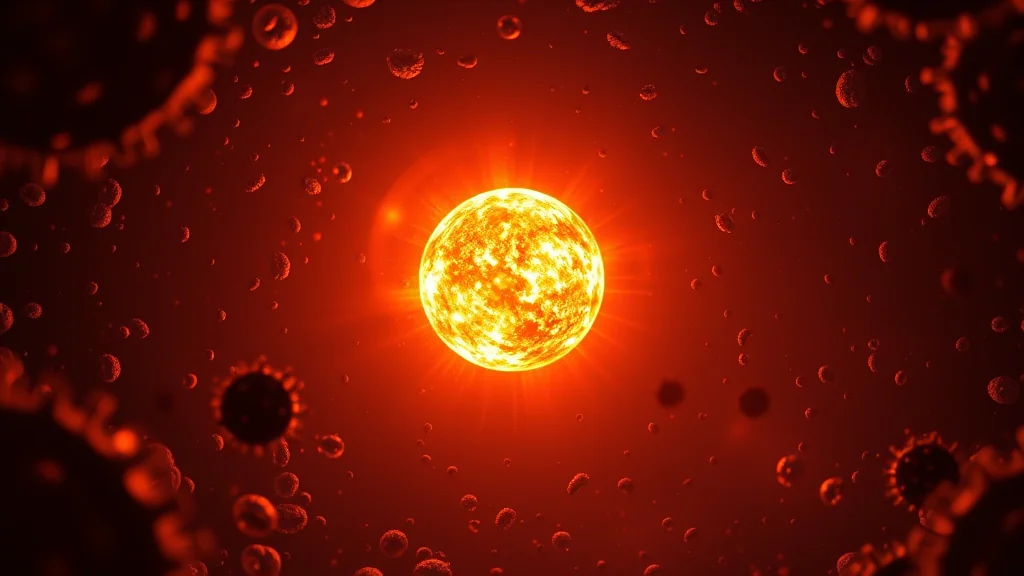
Major Solar Flare Event: An M6.9 Occurrence on August 25th
The Sun, often overlooked in daily life despite being the central star of our solar system, recently made headlines with a significant event—an M-class solar flare categorized as an M6.9, which peaked early morning on August 25th. This event has sparked global interest due to its potential impacts on Earth's technological infrastructure and communication systems.
Understanding Solar Flares
Solar flares are sudden bursts of energy released from the Sun’s surface, primarily originating in active regions known as sunspots where magnetic fields are exceptionally strong. These flares can emit high-energy particles such as electrons, protons, and heavier ions into space. The classification system for solar flares ranges from A-class (the weakest) to X-class (the strongest), with M-class being a significant mid-level category.
Why Is This Solar Flare Trending Now?
The recent occurrence of an M6.9 solar flare on August 25th is capturing global attention for several reasons:
- Scientific Curiosity and Research: The event provides valuable data for scientists studying space weather, aiding in the understanding of solar dynamics and their effects on Earth.
- Potential Technological Impacts: M-class flares are known to cause disruptions in satellite communications, radio transmissions, and GPS signals. While an M6.9 is not as powerful as a major X-class flare, it still warrants attention due to its potential to affect various technologies.
- Risk of Increased Aurora Activity: Solar storms often lead to increased auroral displays around the polar regions. Spectators and researchers are eager to observe if this event enhances the visibility of the northern lights (aurora borealis).
Key Details About the M6.9 Flare
The flare was detected by multiple space observatories, including NASA's Solar Dynamics Observatory (SDO) and other international partners. Observations indicated that this particular event did not directly face Earth but was oriented in a way that minimized its direct impact on our planet’s magnetic field.
- Timing: The flare peaked at approximately 03:16 UTC on August 25th, marking it as an early morning event by global standards.
- Energetic Particles: While the direct impact on Earth was limited due to its orientation, there is still potential for enhanced radiation levels around Earth's orbit and polar regions. This could affect high-altitude aircraft flights and astronauts in low-Earth orbit.
- Auroral Predictions: Despite not being directly aimed at Earth, the flare’s energy release may still contribute to increased geomagnetic activity, potentially enhancing aurora visibility for those situated in higher latitudes.
What to Expect Next
The occurrence of this M6.9 solar flare serves as a reminder of the dynamic nature of our Sun and its influence on Earth’s space environment. As we continue monitoring, here are key points to watch:
- Ongoing Monitoring: Scientists will keep an eye out for any additional flares that might occur in the coming days or weeks.
- Satellite and Ground-Based Observations: Continued observations from satellites like SDO, as well as ground-based telescopes, will provide critical data to understand solar dynamics.
- Predictive Modeling: Researchers are refining models that can predict the likelihood of future flares based on current activity levels and patterns observed in recent years.
The August 25th M6.9 flare is not just a scientific curiosity but also a reminder of our interconnectedness with space weather phenomena. As we continue to rely more heavily on satellite communications, navigation systems like GPS, and other technologies susceptible to solar activity, understanding these events becomes increasingly crucial.